
Open house seller reports answer the one question every owner asks the moment you lock up: was that worth it? You spent their Saturday afternoon walking strangers through their kitchen. They vacuumed, hid the dog, and left for three hours.
If your answer is "pretty good turnout, a few interested people," you sound like every agent they've ever worked with. If your answer is a one-page PDF in their inbox before they pull back into the driveway, with the visitor count, the interest mix, represented versus unrepresented buyers, and the feedback that actually came up, you sound like the agent they tell their neighbors about.
That is what the OpenHouse seller report does. Every sign-in you capture during the event gets qualified on the spot, and when you end the open house, the app assembles an open house report for sellers automatically, on the device, with no server round-trip. AirDrop it, text it, or email it before you've locked the door.
Why "how did it go?" deserves a real answer
Sellers are not naive. They know an open house is partly a buyer-finding exercise and partly lead generation for the agent. The National Association of Realtors' research has tracked for years how buyers actually find homes, and open houses remain a real but not dominant part of the search. Your seller has probably read some version of that. So when they ask how the open house went, they are asking two things: did this help sell my house, and is my agent doing real work or just going through the motions?
A vague verbal recap answers neither. An open house traffic report answers both. Eleven groups came through. Three were hot: actively searching, pre-approved or close to it, no agent. Five were warm. Two were neighbors, which is fine. Neighbors talk. Sixty-four percent of visitors were unrepresented, which tells you the marketing pulled in genuine early-stage buyers rather than agent-toured shoppers. And the feedback clustered on two themes: people loved the backyard and balked at the carpet in the main bedroom.
That last part is the quiet superpower of a good open house feedback summary. "Three separate visitors mentioned the carpet" is evidence. It moves a pricing or staging conversation from your opinion versus theirs to something the market said. Agents who bring an open house seller report to that conversation get price adjustments approved more often, because they stop being the bearer of bad news. They become the messenger for eleven real visitors.
What's inside the open house seller report
The report is one page on purpose. Sellers don't want a dashboard; they want to know what happened. Here is what every open house seller report includes:
| Section | What the seller sees | Why it matters |
|---|---|---|
| Visitor count | Total sign-ins for the event | The headline number, proof of foot traffic |
| Interest mix | Hot / warm / cold breakdown | Shows quality, not just quantity |
| Representation | % agent-represented vs. unrepresented | Signals whether marketing reached fresh buyers |
| Feedback themes | Recurring comments, grouped | Ammunition for pricing and staging conversations |
| Event details | Date, time, property address | Makes each report a clean record for the listing file |
Visitor count, without the clipboard math
The count is only as good as the capture. OpenHouse runs as a single-screen iPad kiosk, so visitors actually complete the sign-in. No half-legible paper sheet to transcribe later, no "I'll just wave them in, it's busy" gaps. The visitor count on the open house seller report reflects what really happened, and you never have to reconstruct it from memory on Sunday night.
The hot/warm/cold mix
Raw traffic flatters slow markets and undersells busy ones. Twenty sign-ins where eighteen are neighbors is a very different event from eight sign-ins where three are unrepresented buyers ready to transact. The qualification questions you ask during sign-in (timeline, financing, representation) feed straight into the interest mix, so the report separates a crowded-but-cold event from a quiet-but-promising one. That's the difference between a listing activity report a seller skims and one they act on.
Represented vs. unrepresented percentage
This number does double duty. For the seller, it shows whether the open house attracted buyers who haven't already toured the home with their own agent. For you, it's the size of your callback list. The open house seller report shows the percentage; the names and numbers behind it stay with you.
Feedback themes, not raw quotes
Visitors say things at open houses they'd never say to a seller's face. That candor is useful, but raw quotes can sting, and they occasionally identify the person who said them. The report groups feedback into themes ("layout praised," "price resistance at current ask," "main bath dated") so the seller gets honest market signal without anyone's words being traced back to them.
Ready before you lock the door
Most reporting tools treat the report as a Monday task: sync the data, log into a portal, generate, download, send. By Monday the seller has already formed their own conclusion about the event, usually a pessimistic one, in the information vacuum you left behind.
OpenHouse generates the open house seller report the moment you end the event, because there is nothing to sync. Every sign-in was captured and qualified locally. The app is offline-first by design, so a dead-zone listing with no Wi-Fi changes nothing. End the event, tap once, and the PDF is ready to share while you're still turning off the lights. Sending it is literally the wrap-up step in our open house checklist: lights off, doors locked, report sent.
Speed reads as competence. An open house seller report that lands within minutes of the event ending tells the seller their agent runs a tight operation. The same report arriving Tuesday says the opposite, even when the numbers are identical.
Bring the open house seller report to listing appointments
Most agents treat the seller report as something that happens after the event. It also belongs on the table before you have the listing, and it may do more work there than anywhere else.
At a listing appointment, every agent says some version of "I'll hold open houses and keep you informed." It's unfalsifiable, so sellers discount it. Now slide a sample seller report across the table instead:
"This is the report you'll get after every open house I hold, usually before I've left your driveway. Visitor count, how serious they were, how many came without an agent, and what they said about the house. You'll never have to ask me how an open house went, because you'll already know."
That's a concrete promise a seller can inspect. App roundups like The Close's review of open house tools keep landing on the same observation: lead capture is table stakes in this category, and what separates tools (and agents) is what happens after the sign-in. Coverage at HousingWire makes a similar point. The apps worth using turn an afternoon of foot traffic into something an agent can act on and show. An open house seller report is the visible, seller-facing half of that system, and the half that wins listings.
A practical tip: keep one anonymized sample report in your listing presentation folder. A past event with the address redacted works, and so does a demo event you run at home. Walking a seller through it takes thirty seconds, and it reframes the whole open-house conversation from "will you do them?" to "this is the accountability you get every single time."
Privacy: the seller gets the story, you keep the leads
There's a line that matters here, and OpenHouse draws it on purpose. The open house seller report contains aggregates only: counts, percentages, and grouped themes. It never includes visitor names, phone numbers, or email addresses.
Three reasons the line sits where it does:
- Visitors signed in to view a house, not to have their contact details forwarded to the homeowner. Sharing PII with the seller would betray that expectation, and visitors who suspect it stop giving real numbers.
- The seller doesn't need the contacts to evaluate the event. "Three hot, unrepresented buyers" is the fact that matters for their decisions. The phone numbers are your follow-up job, not their reading material.
- The leads are your business asset. The relationship with those buyers, including the ones who won't buy this particular house, is the long-term return on your Saturday.
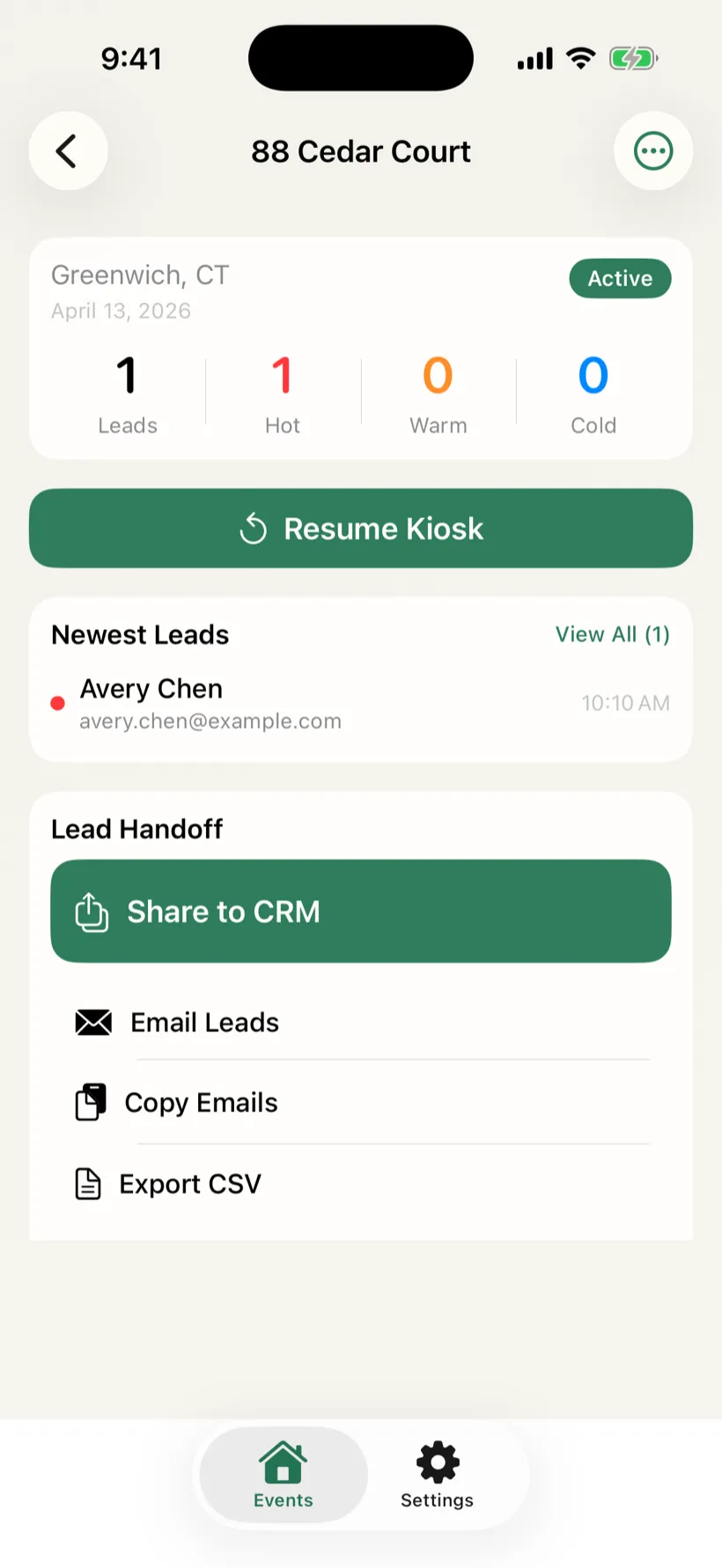
The full lead detail lives in the app on your device, where you can work it directly or export the underlying lead data into whatever system you run your follow-up from: CSV, Contacts, vCard, or a direct handoff. Seller gets the summary; you keep the pipeline. Both sides get exactly what they should.
And the data never touches a server in between. OpenHouse makes zero network calls during capture and report generation, requires no account, and doesn't monetize visitor data through lender placements or resale. The open house traffic report your seller receives was assembled entirely on your iPad.
Where the open house seller report fits in the workflow
The report works because everything upstream of it feeds it. The kiosk keeps sign-ins complete, qualification happens during the conversation rather than from memory, and the event wrap-up turns all of it into the PDF in one tap. If you're evaluating the app end to end, the seller report is the last mile of the rest of the toolkit: capture, qualify, report, follow up.
A simple cadence that works:
| When | What you do | What the seller gets |
|---|---|---|
| During the event | Kiosk captures and qualifies every visitor | Nothing yet, no interruptions |
| Doors locked | End event, report auto-generates | One-page PDF within minutes |
| Same evening | You start follow-up with hot leads | Confidence their agent is on it |
| Next price/staging talk | You cite feedback themes from the report | A data-backed conversation, not a debate |
Run that loop on every open house and two things happen. Your current sellers stop wondering what you do all weekend. And your future sellers, the neighbors who walked through and the referrals who hear about the report, start expecting this from any agent they hire. Be the agent who set that expectation.
If you want your next open house feedback summary to look like this, try OpenHouse. The open house seller report is built into the app, and it's ready before you've locked the door.
Open house seller report template: what to include
If you were building an open house seller report template from scratch, in a Word doc, a Numbers file, a Notion page, here is the structure that works. This is also exactly what OpenHouse generates automatically, which is why it's worth understanding before you see it.
Header block
Property address, open house date and hours, the agent's name and contact info. This turns the report into a document the seller can file, they may own multiple properties or have multiple events, and a dateless PDF is useless in three months.
Visitor count
One number. Total sign-ins for the event. Resist the urge to embellish it. If six people came through, write six. Sellers who get honest numbers for six mediocre events and then suddenly see fourteen on a Saturday where the price dropped understand what happened. Inflating early counts destroys that signal.
Interest-level breakdown
| Interest | Criteria | Count |
|---|---|---|
| Hot | Active buyer, timeline ≤ 90 days, pre-approved or near it, no agent | , |
| Warm | Interested but timeline uncertain, or represented | , |
| Cold | Neighbor, curious passerby, investor browsing | , |
The criteria matter. Your template should define what earns each label so the seller understands what "three hot buyers" actually means, not just that you liked three of the visitors.
Represented vs. unrepresented split
A percentage, not a raw count, so it is comparable across events of different sizes. "64% unrepresented" means the marketing pulled in people who have not already been toured by a buyer's agent. That is the audience most likely to write an offer without splitting the commission.
Feedback themes
Three to six bullet points, grouped by topic. Not raw quotes, themes. The open house seller report template for this section looks like:
- Backyard and outdoor space: universally positive
- Main bedroom carpet: mentioned by three separate visitors as a concern
- Price relative to the neighborhood comp on Elm Street: two visitors referenced it
This is the section that moves seller conversations. "Three separate visitors mentioned the carpet" is a market signal, not your opinion. See the Privacy section above for why you group themes instead of attributing quotes.
Agent notes (optional)
A brief field for context that didn't fit the structured sections: unusual weather, a competing listing that opened the same afternoon, a buyer who expressed serious interest and will be contacted Monday. Keep it short, two or three sentences. The seller doesn't need your to-do list; they need to know you noticed things.
One-page rule
The open house report for sellers should fit on a single page. If it runs over, you're probably including information the seller doesn't need (like full lead lists or detailed visitor profiles, those stay with you). A seller report that requires scrolling gets skimmed or filed without being read. One clean page gets read.
OpenHouse follows this template exactly, assembled on-device the moment you end the event. You don't fill in a form; the app builds it from what it already captured during sign-in.
What questions to put on an open house feedback form for sellers
This sub-topic sits at the boundary between two documents: the sign-in form visitors fill out, and the seller report the agent sends. They are separate things with different audiences, and it's worth being precise about what goes where.
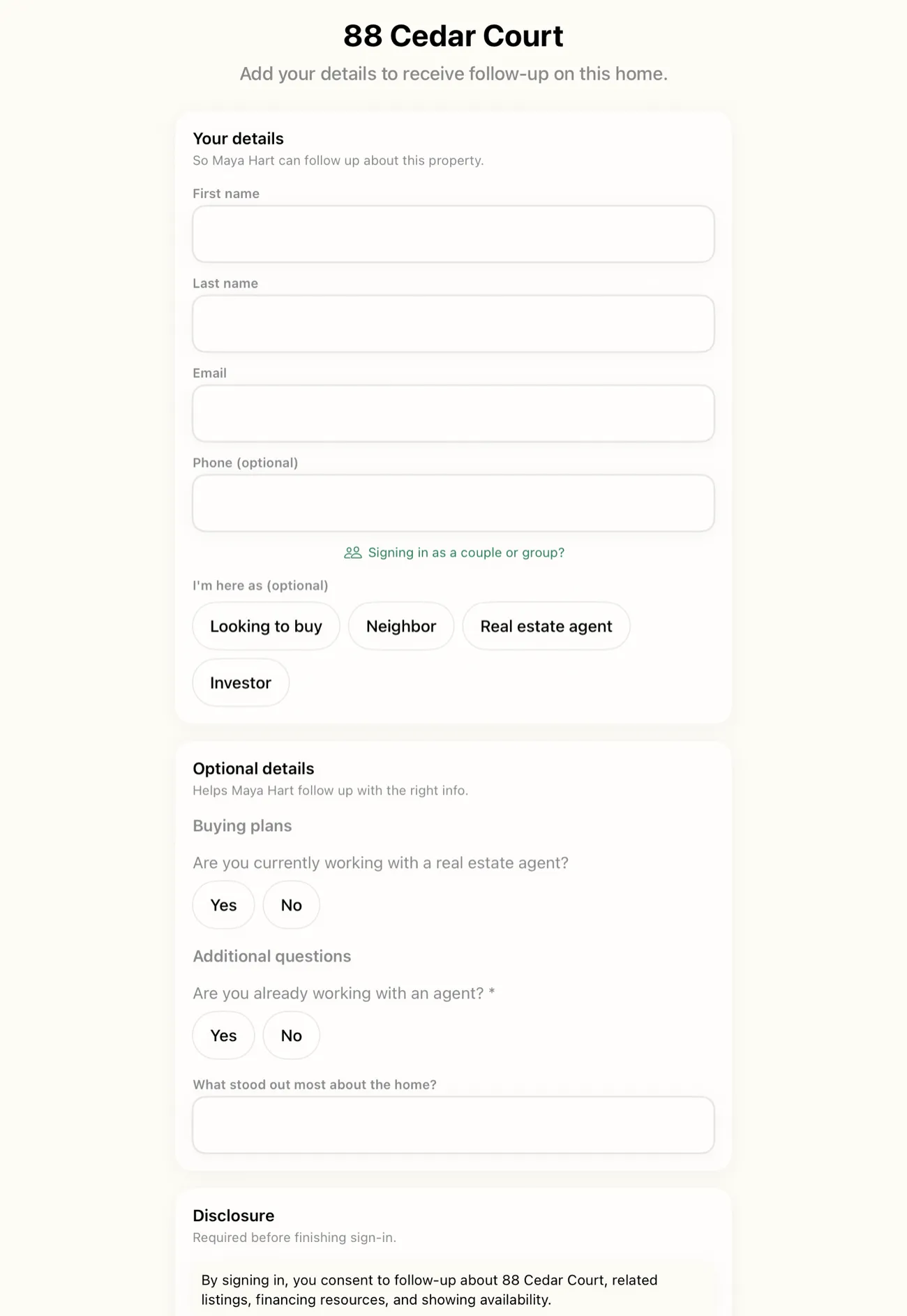
The sign-in form (what visitors see) captures contact information and enough qualifying data to power the seller report. The seller report (what the seller sees) is the aggregated output. The form questions determine the quality of the output, so getting them right matters.
For a complete walkthrough of designing the visitor-facing form, including which questions to ask, field order, privacy language, and how to handle reluctant visitors, see the open house feedback form guide. That page owns the form design how-to in depth.
What belongs here is how the sign-in questions connect to the open house report for sellers, specifically, which question answers feed which report sections:
| Sign-in question | What it powers in the seller report |
|---|---|
| Name + contact info | Stays with agent only; not in seller report |
| Purchase timeline | Hot/warm/cold interest classification |
| Financing status | Hot/warm/cold interest classification |
| Working with an agent? | Represented vs. unrepresented percentage |
| What do you think of the home? (open text) | Feedback themes section |
| How did you hear about the open house? | Optional: marketing-source insight for agent |
A few notes on what to put on the open house feedback form:
Keep qualifying questions to three or four. Timeline, financing, and representation status are the three that directly power the seller report. More than four questions and visitors start skipping fields or declining to sign in. The open house feedback form for sellers works best when it feels like a quick check-in, not a mortgage application.
The "what do you think?" question is optional but valuable. Many agents skip it because it feels awkward at a sign-in kiosk. The visitors who do answer it, however, give you the candid market feedback that makes the seller report actually useful, the carpet comment, the price concern, the observation about the neighbor's fence. Even a few honest responses per event are worth having the field there.
Don't ask questions you won't use. If your seller report template doesn't include a marketing-source breakdown, don't collect "how did you hear about this?", it wastes visitors' time and creates data you won't act on. The form and the report should have a one-to-one relationship: every sign-in field feeds something in the output.
OpenHouse's built-in sign-in form is designed around exactly this mapping. The qualification questions it collects are the ones that power the interest-level breakdown and representation split in the open house seller report template, nothing extra, nothing missing. If you want to go deeper on designing the form itself before your next event, the open house feedback form guide covers it question by question.
Frequently asked questions
What does the open house seller report include?
The report covers total visitor count, the hot/warm/cold interest mix, the percentage of agent-represented versus unrepresented visitors, and the recurring feedback themes from the event. It is a one-page PDF the seller can read in under a minute.
Does my seller see the visitors' contact information?
No. The seller report contains aggregates only, counts, percentages, and themes. Names, phone numbers, and emails stay with you on your device, which protects visitor privacy and keeps the leads where they belong.
When is the seller report ready?
Immediately. Because OpenHouse captures and qualifies every sign-in locally during the event, the report is generated on-device the moment you end the open house, no syncing, no waiting for a server, no Wi-Fi required.
Can I use the seller report in a listing presentation?
Yes, and you should. Bringing a sample report to a listing appointment lets you show prospective sellers exactly what they will receive after every open house, which is concrete proof of accountability that most competing agents cannot match.
Does the report work if the house has no Wi-Fi?
Yes. OpenHouse is offline-first, so sign-ins, qualification, and report generation all happen on the device. You can share the PDF later from anywhere with a connection, or AirDrop it on the spot.
What should an open house seller report template include?
A solid open house seller report template covers five things: total visitor count, an interest-level breakdown (hot/warm/cold), the percentage of agent-represented versus unrepresented buyers, grouped feedback themes, and the event details (date, time, address). Keep it to one page so the seller actually reads it.
What questions should I put on an open house feedback form for sellers?
The questions that power the seller report are the ones you ask visitors during sign-in: their purchase timeline, financing status, and whether they are working with an agent. Their candid reactions to the home, price, layout, condition, come out in conversation and get logged as feedback themes. For a full breakdown of form design, field order, and what to ask, see the open house feedback form guide.
How is the open house seller report different from the feedback form?
The feedback form is what visitors fill in when they sign in, it captures their name, contact details, and initial impressions. The seller report is what the agent sends the seller afterward: an aggregated summary with no visitor PII, just counts, interest levels, and feedback themes. One is the input; the other is the output.