
Best open house apps lists are usually written by people who have never stood door duty in an empty colonial with no Wi-Fi and a line of visitors squinting at a clipboard. This one is different in two ways, and you deserve to know both up front. First: we make one of the apps on this list. OpenHouse is ours, and you should apply a discount to everything nice we say about it. Second: because we build in this category, we know where each of these apps breaks, including ours. So you get real pricing, the standout reason to pick each one, and the trade-off its own marketing page won't mention.
How we ranked the best open house apps
Generic roundups rank on screenshots and feature checklists. We ranked on the five things that decide whether you leave an open house with usable leads. This is the same approach behind our methodology and all head-to-heads, and it lines up with our open house sign-in app buyer's guide if you want the category framed by what to look for rather than by brand. Here is how we score, so you can check our work:
- Offline reliability. Vacant listings have famously bad connectivity. Does sign-in keep working, fully, not in a degraded queue-and-pray mode, when the network dies?
- Sign-in completion speed. Every extra screen between "hi, come on in" and a captured lead loses visitors. We timed how fast a stranger can finish signing in.
- Lead export. A lead trapped inside an app is a lead you will not follow up on. CSV, vCard, Contacts, CRM handoff: how clean and how fast?
- Privacy and data handling. Who else sees your visitor's phone number? Some free open house apps are free because the lead data funds them.
- Price. What it costs, what's actually included, and what happens to your data if you stop paying.
We did not rank on follow-up automation, social media tools, or anything else that happens after the event. Partly because that is not what an open house sign-in app is for, and partly because, in fairness, our app deliberately doesn't do those things.
The best open house apps at a glance
| Rank | App | Best for | Pricing | The trade-off |
|---|---|---|---|---|
| 1 | Curb Hero | Best free open house app | Free | Monetized via lender co-marketing; lead data can be shared with lenders |
| 2 | OpenHouse (ours) | Best for privacy + offline reliability | $9.99/mo or $79.99/yr, 1-month free trial | Paid, iOS/iPadOS only, no marketing automation |
| 3 | Open Home Pro | Established tablet option | See their site | Tablet-only sign-in; offline mode syncs later rather than working locally |
| 4 | Showable | Sign-in plus seller-facing extras | Paid; current plans on their site | Newer entrant with a smaller track record |
| 5 | Paper / printable template | Zero-cost fallback | Free | Manual retyping, no privacy between visitors, no qualification |
This list sticks to dedicated sign-in tools. If you are weighing a full CRM platform that bolts sign-in onto everything else, we cover those separately in OpenHouse vs Brivity and OpenHouse vs BoldTrail, and in a longer review of Brivity's open house feature on its own terms.
Now the detail, in order.
1. Curb Hero: best free open house sign-in app
Yes, we are putting a competitor first. Curb Hero is the most popular app in this category for a reason. It is genuinely free, it is polished, and its App Store rating (4.9 stars across a large review base) is earned. If your only requirement is "digital sign-in that costs nothing," this is the answer, and any list of the best open house apps that pretends otherwise is selling you something.
- Pricing: Free.
- Standout: A complete, well-designed sign-in experience, including QR sign-in, single-property pages, and social integrations, at zero cost.
- Trade-off: It is free because of lender co-marketing. Curb Hero's own help center explains that a default lender may be assigned to your listings and that lead information is shared with lenders when visitors opt into mortgage questions. For many agents that is a fine bargain, and some teams already co-market with a lender anyway. But it means your visitor's data has a second audience, and you should disclose that to yourself before a visitor discloses their phone number to you.
If you are weighing this one against ours, we wrote up OpenHouse vs Curb Hero in depth rather than rehashing it here.
2. OpenHouse: best open house app for privacy and offline reliability (ours)
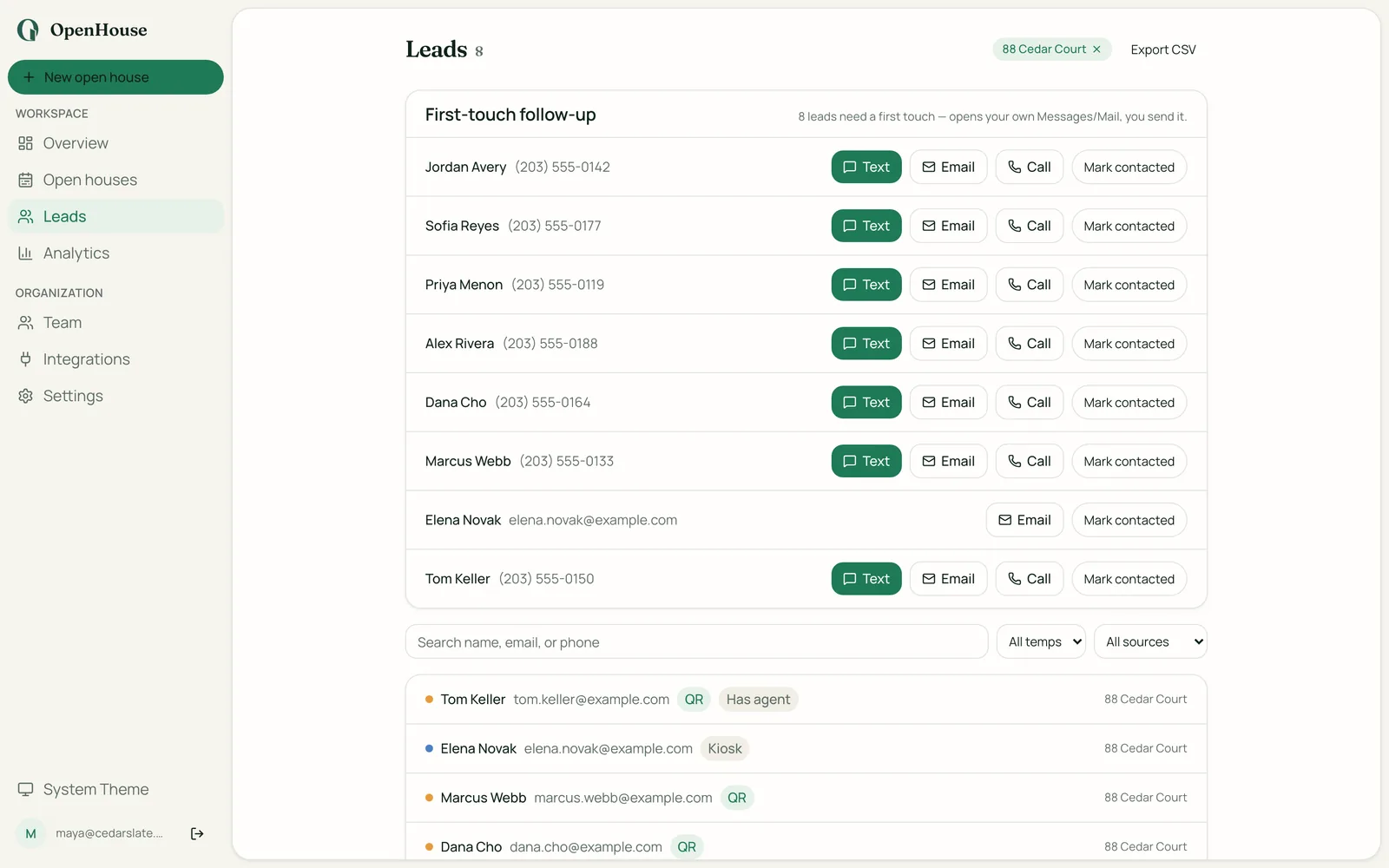
This is our app, so here is the pitch and the discount together. OpenHouse exists because we kept hitting the same two failures at real open houses: sign-in apps that stalled the moment the listing's Wi-Fi did, and "free" tools where the visitor data quietly traveled somewhere else. So we built the opposite. An iPad-first sign-in kiosk that makes zero network calls. No account, no backend, no sync. Every sign-in is written to the device, qualified on the spot (represented buyer, unrepresented hot lead, neighbor, investor), and exported on your terms: CSV, PDF, Contacts, vCard, or a share-to-CRM handoff. Built-in kiosk mode keeps visitors out of the rest of your iPad without you fiddling with Apple's Guided Access settings, though that works too.
- Pricing: $9.99/month or $79.99/year, with a one-month free trial. If your subscription ever lapses, the app drops to a read-only mode where your captured leads stay viewable and exportable. Your data is never held hostage.
- Standout: Privacy by architecture. Leads physically cannot leave the device unless you export them, and a dead-zone listing works exactly like a connected one because nothing waits on a network.
- Trade-off: It is paid while the category leader is free; it is iOS/iPadOS only; and it deliberately is not a CRM. No drip campaigns, no marketing suite. It captures and qualifies at the door, then hands the leads to your real system. If you want the platform experience, pick something else on this list.
If that trade reads like the right one for how you work, you can try OpenHouse free for a month and judge the kiosk at a real event instead of taking our word for it.
3. Open Home Pro: the established tablet option
Open Home Pro has been around longer than almost anything else here, and longevity counts. Plenty of agents have run hundreds of open houses on it without drama. It is a tablet-centric tool, with sign-in on iPads and Android tablets rather than phones, plus lead capture, simple follow-up emails, and listing feedback questions.
- Pricing: Listed on their homepage; we won't quote numbers that may have changed since we checked.
- Standout: Maturity. It is a known quantity with years of agent use behind it, and the tablet-only focus keeps the sign-in flow simple.
- Trade-off: That tablet-only design means no phone fallback if your iPad dies mid-event, and its offline handling is a sync-later model. Sign-ins are held and uploaded when a connection returns, rather than the app being fully local. Sync-later usually works. "Usually" is the word doing the heavy lifting at a listing with no signal.
We compare the offline models directly in OpenHouse vs Open Home Pro in depth if that distinction matters to you, and if you are weighing the two established names against each other, Curb Hero vs Open Home Pro puts them side by side.
4. Showable: sign-in with seller-facing extras
Showable is the newest entrant on this list, and to their credit they publish their own comparison of open house sign-in apps, which is more homework than most vendors do. The product pairs visitor sign-in with seller-facing touches like showing feedback, aimed at agents who want the open house data to double as a listing-client deliverable.
- Pricing: Paid; current plans are on their site.
- Standout: The seller-reporting angle. Turning sign-in data into something you can show the homeowner is an underrated way to win the next listing.
- Trade-off: A smaller track record than Curb Hero or Open Home Pro. That is not a criticism, since every app on this list was new once, very much including ours. But if you need years of reviews before trusting an app with door duty, you will want to wait or test it on a low-stakes event first.
5. Paper sign-in sheet: the fallback that refuses to die
No fair ranking of open house apps skips the non-app. A printed sign-in sheet costs nothing, never runs out of battery, and works in any dead zone. For an agent doing two open houses a year, it may genuinely be enough.
- Pricing: Free.
- Standout: Absolute reliability and zero setup.
- Trade-off: Everything else. Handwriting you will misread, every contact manually retyped into your phone or CRM, zero qualification, and no privacy. Visitor #9 can read the names and numbers of visitors #1 through #8, which is exactly the kind of thing that makes careful buyers write "n/a" in the phone column. Paper is a fallback, not a strategy.
Where does Spacio fit?
If an older roundup pointed you at Spacio: it is still around. Spacio (the HomeSpotter sign-in product, now under Lone Wolf) is in the App Store and was last updated in May 2026. The reason it is not ranked above is fit, not availability. OpenHouse takes a different position on the things we score: fully offline capture with zero network calls, leads that stay on your device and are never sold, no lender co-branding, flat pricing ($9.99/mo or $79.99/yr with a one-month free trial), and export-first CRM handoff to Follow Up Boss, HubSpot, BoldTrail, Lofty, Sierra, CSV, or vCard. If you want the head-to-head, read OpenHouse vs Spacio or the fuller Spacio review. Note that Spacio does not list pricing publicly. Several big-publisher lists, like The Close's open house app roundup, feature it too, so check the publish date on anything you read in this category, including this page.
Which of the best open house apps should you actually pick?
Strip away the rankings and it comes down to one question: what are you willing to trade for your visitor data?
- Trade nothing, accept lender co-marketing: Curb Hero. The best free open house app, period. Just know how the bill gets paid.
- Trade $9.99/month for privacy and a kiosk that works in a dead zone: OpenHouse. We are biased about the app. The architecture works the same either way.
- Trade phone flexibility for a long track record: Open Home Pro on a dedicated tablet.
- Trade a shorter track record for seller-report extras: Showable.
- Trade your Monday morning to retyping: paper.
Whatever you choose, run it once at a low-stakes open house before a busy Sunday. Sign yourself in as a fake visitor, kill the Wi-Fi, and try the export. The best open house app for you is the one that survives that drill, and ten minutes of testing beats any list on the internet, including ours.
Best open house app for iPhone
Most of the conversation in this category defaults to iPad, and for good reason: a 10-inch screen is easier for a visitor to fill out, harder to accidentally walk off with, and sits naturally on a counter. But plenty of agents do open houses with whatever is in their pocket, which means iPhone.
The good news is that the two most capable apps on this list, Curb Hero and OpenHouse, both run natively on iPhone. Curb Hero's QR-code sign-in flow actually works particularly well on a phone: visitors scan from their own device and fill in their contact details without touching yours at all. OpenHouse runs its single-screen sign-in on iPhone with the same offline behavior as iPad, though the built-in kiosk mode is more comfortable on a larger screen.
Open Home Pro is tablet-only for sign-in, so iPhone is not an option there.
A few practical notes for iPhone door duty:
- Prop or case it. A phone flat on a table is easy to grab. A case with a stand, or a small phone mount, makes "please sign in here" feel intentional rather than improvised.
- Skip kiosk mode if you're holding the device. Kiosk mode is designed for unattended iPad setups. When you're present at the door, you control the device, so the normal app is fine.
- Test the form size. A sign-in form that works well on iPad may be cramped on a 6-inch screen. Try it yourself before your first event and trim optional fields if the experience feels slow.
For a deeper look at running an open house specifically from your phone, which app versions to install, how to set up the screen, and what to do when a visitor can't type on a tiny keyboard, see our open house app for iPhone guide. This section covers which apps work on iPhone; that guide covers how to actually run the event on one.
Best open house app for iPad
The iPad has become the default kiosk device for open house sign-ins, and the category is designed around it. Tablet-sized screens give visitors enough room to type comfortably, they sit flat on a kitchen counter without propping, and a locked-down kiosk mode keeps them from poking around your files between visitors.
What actually differs between apps on iPad is how they handle two things: kiosk behavior and offline reliability.
Kiosk behavior. Some apps rely on Apple's Guided Access to lock the device to a single screen, which works, but requires you to remember to turn it on and set a PIN each time. OpenHouse has a built-in kiosk mode that you enable once per event directly inside the app, no system settings required. Open Home Pro's tablet-first design includes its own screen-lock approach as well.
Offline reliability. This is where iPad open house apps diverge most. A listing that has no Wi-Fi signal, and many do, especially new construction and vacant properties, will expose whether your app works locally or just queues and waits. OpenHouse makes zero network calls: the sign-in form, the lead capture, and the qualification all happen on-device, with no dependency on a connection. Open Home Pro uses a sync-later model, where sign-ins are held on-device and uploaded when a connection returns. That usually works; the risk is the edge cases. Curb Hero is more connection-dependent for its full feature set, though basic sign-in will often still complete in degraded form.
For a full comparison of the open house sign in app category, framed by what to look for rather than by brand ranking, the open house sign in app buyer's guide walks through the decision criteria in more depth. This page ranks the apps; that page explains the tradeoffs by feature.
| App | iPad support | Kiosk mode | Offline model |
|---|---|---|---|
| OpenHouse | Native iPad + iPhone | Built-in (no Guided Access needed) | Fully local, zero network calls |
| Open Home Pro | Tablet-only (iPad + Android) | Built-in | Sync-later |
| Curb Hero | iPad + iPhone + web | None built-in (Guided Access works) | Connection-preferred; QR fallback |
| Showable | iPad + iPhone | None noted | Not tested by us |
The iPad support column describes native apps, not who can run what. OpenHouse's native app is iPhone and iPad only, but the web app runs in any Android browser, and visitors can sign in on their own phones by QR with nothing to download. The open house app for Android guide walks through all three routes, including which apps on this list ship a native Android build.
Best open house app for realtors
"Best open house app for realtors" means something slightly different depending on what part of the transaction you are thinking about. If you are a listing agent, the primary job is capturing every visitor's contact and handing the seller a clean report at the end. If you are a buyer's agent who happens to be running an event, the priority is qualifying leads quickly and getting them into your CRM without manual retyping. Solo agents doing two or three open houses per month have different needs than a team running ten per weekend.
Here is how the apps map to those scenarios:
Solo agent, listing focus. OpenHouse was built for this scenario. The seller report feature, a summary you can text or email the homeowner after the event, is specifically aimed at agents who want the open house sign-in data to do double duty as a listing-client touchpoint. Combined with privacy-first lead handling (your clients' visitors don't end up in a lender's pipeline), it is designed around the listing agent's relationship.
Team or brokerage, volume focus. Curb Hero's free tier works well at scale: multiple agents can run events simultaneously, the lender co-marketing model is often acceptable in broker-preferred lender arrangements anyway, and the polish of the product holds up under heavy use. Some brokerage teams also use Open Home Pro for its tablet-centric workflow, which can be easier to standardize across multiple agents when everyone is using the same device type.
Agent who needs automation after the door. None of the dedicated sign-in apps in this list are CRMs. If you need follow-up sequences, drip campaigns, or full buyer pipeline management attached to your open house sign-ins, you are better served by a platform like Brivity or BoldTrail that includes sign-in as one module among many. We cover those trade-offs in OpenHouse vs Brivity and OpenHouse vs BoldTrail.
Agent on a zero-software budget. Curb Hero is the only genuinely free option in this category, and it earns its rating. The trade-off is lender co-marketing, worth understanding before you recommend it to a privacy-conscious seller client, but fine for many agents' workflows.
The best open house app for realtors is not a single answer; it is the one whose trade-offs match how you actually run your business. A high-volume team coordinator and a solo agent doing weekend opens have real reasons to land on different apps.
Frequently asked questions
Is there a free open house sign-in app?
Yes. Curb Hero is genuinely free and well-reviewed. It is monetized through lender co-marketing, which means lead data can be shared with a paired lender when visitors opt into mortgage questions, so read the terms before your first event.
What is the best open house app for iPad?
Most sign-in apps run on iPad, but they differ in kiosk behavior and offline reliability. OpenHouse was built iPad-first with kiosk mode and zero network dependence; Open Home Pro is tablet-only by design and syncs leads later; Curb Hero runs on iPad alongside phones and the web.
Do open house apps work without Wi-Fi?
It depends on the app. Cloud-first apps generally queue sign-ins and sync when a connection returns, which works until it doesn't. OpenHouse stores every sign-in on the device itself with no network calls, so a dead-zone listing behaves exactly like a connected one.
Is Spacio still available?
Yes. Spacio (from HomeSpotter, a Lone Wolf company) is still in the App Store and was last updated in May 2026. If you are comparing it with OpenHouse, the differences are architectural: OpenHouse captures fully offline with zero network calls, keeps leads on the device and never sells them, charges a flat $9.99/mo or $79.99/yr with a one-month free trial, and exports to Follow Up Boss, HubSpot, BoldTrail, Lofty, Sierra, CSV, or vCard. For the full comparison, see OpenHouse vs Spacio.
Do I still need a paper sign-in sheet as a backup?
Only if your app depends on a connection. A printed sheet costs nothing and never crashes, but every name has to be retyped and visitors can read each other's details. With a genuinely offline app, paper becomes optional rather than insurance.
What is the best open house sign in app for realtors in 2026?
It depends on your priorities. Curb Hero is the best free open house sign in app for realtors who can accept lender co-marketing. OpenHouse is the best paid option for agents who need offline reliability and privacy by architecture. Open Home Pro suits teams already committed to tablet-only workflows.
Can I use an open house app on iPhone instead of iPad?
Yes. Curb Hero and OpenHouse both run on iPhone. For a proper kiosk setup, iPad is more practical because the larger screen is easier for visitors to type on and harder to accidentally pocket. If you only have an iPhone available, it works, just skip kiosk mode and hold the device or prop it up.
What does "best open house sign in app" actually mean, sign-in or sign-up?
In real estate, "sign in" means visitors entering their contact details at the door, not creating an account. An open house sign in app replaces the paper clipboard with a digital form on your phone or iPad, captures the lead on the spot, and lets you export it to your CRM afterward.