
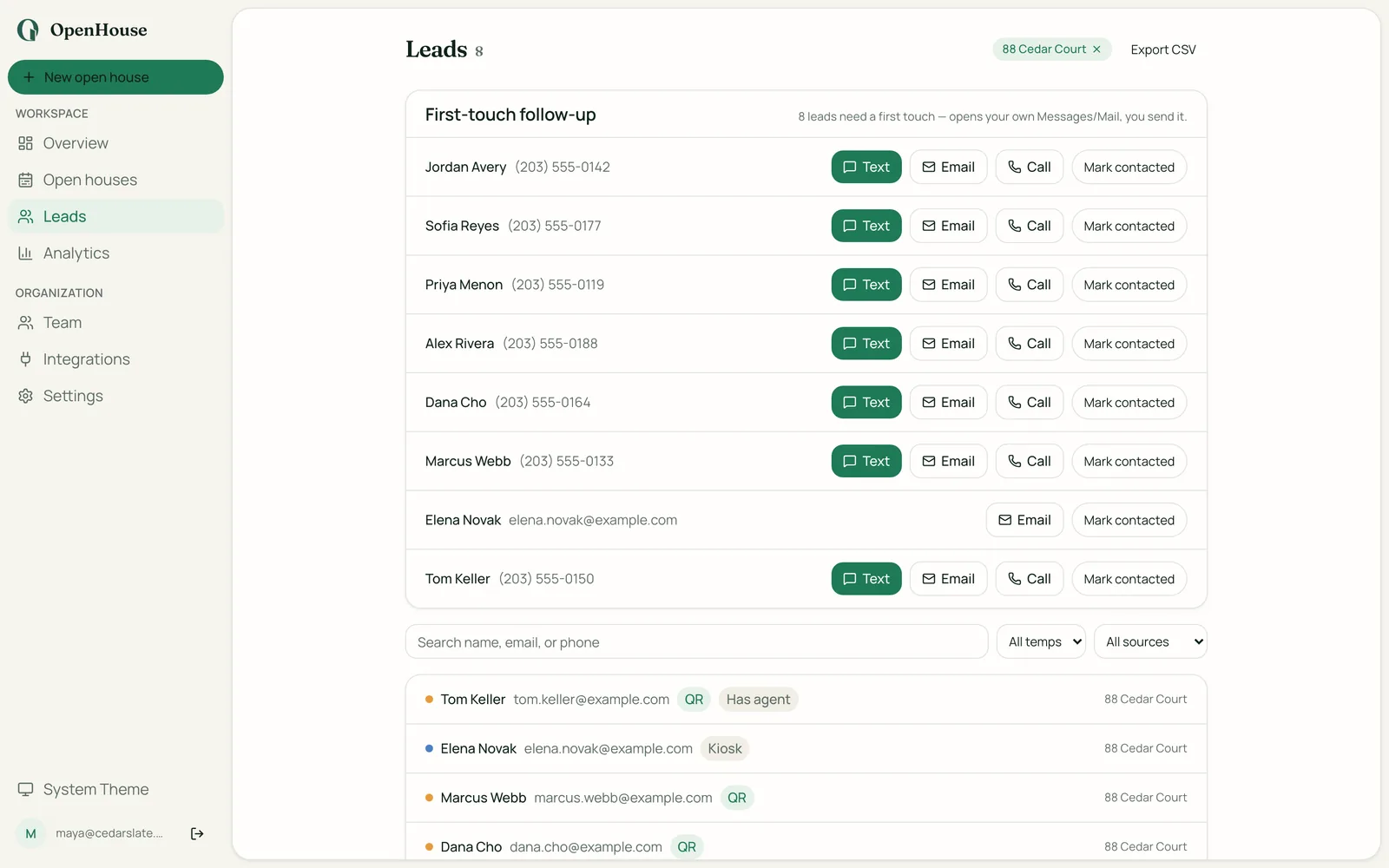
OpenHouse vs Curb Hero comes down to one trade, and you should make it with your eyes open. Curb Hero is free because lenders help pay for it. OpenHouse costs money because nobody else is in the room. Both apps will get a visitor's name onto your follow-up list. What separates them is the funding model and where your lead data ends up. Add one more question, whether sign-in still works when the listing has no Wi-Fi, and you have the whole comparison. One thing first: Curb Hero is the most popular open house sign-in app on the market and it earns its 4.9-star rating. A write-up that pretends otherwise is useless to you, so this one starts from that fact.
The short version
- Choose Curb Hero if free matters most, you like its QR-code marketing tools, and the lender co-marketing model that funds it sits fine with you.
- Choose OpenHouse if you want lead capture that stays private because of how the app is built, works with zero connectivity, requires no account, and hands leads cleanly to the tools you already use. You pay a small subscription so that no lender is ever in the loop.
If you're still earlier in your research, all our app comparisons cover the rest of the field too.
OpenHouse vs Curb Hero: feature comparison
| OpenHouse | Curb Hero | |
|---|---|---|
| Price | $9.99/month or $79.99/year | Free |
| Free trial | 1 month, full app | Not needed; it's free |
| How it's funded | Agent subscriptions only | Lender co-marketing, per its help docs |
| Account required | No | Yes |
| Works with no signal | Yes, zero network calls by design | Built around a connected cloud platform |
| Where lead data lives | On your device until you export it | In Curb Hero's cloud; shared with the paired lender when visitors opt into mortgage questions |
| Lender presence at sign-in | None, ever | A default lender may be assigned to your listings |
| Sign-in experience | Single screen, built-in kiosk mode | Polished digital sign-in with QR code options |
| Buyer qualification | Built-in triage: represented, hot lead, neighbor, investor, incomplete | Customizable sign-in questions |
| Exports & handoff | CSV, PDF, Contacts, vCard, Share to CRM | Integrations through its marketing platform |
| Seller report | Built in | Marketing analytics within the platform |
| Platform | Native iPhone and iPad | Broader multi-platform support |
| If you stop paying | Read-only mode; all data stays exportable | Not applicable |
The table tells you what each app does. The next few sections cover why each one is built that way, because the funding model is the real difference between OpenHouse and Curb Hero. Almost everything else follows from it.
Why Curb Hero is free: the lender pairing model, in their own words
Curb Hero doesn't hide how it works, and credit to them for documenting it plainly. According to Curb Hero's help center, the app can assign a default lender to your listings. When an open house visitor opts into mortgage-related sign-in questions, that visitor's information is shared with the paired lender. Their help doc frames this as co-marketing: the lender gets introduced to potential borrowers, and in exchange the app stays free for agents.
To be fair about how that plays out at a real event: the visitor opts in. Curb Hero isn't selling your contact list behind your back. It runs a disclosed lender co-marketing program, and plenty of agents already work with a lender and actively like having one attached to their listings. If that describes you, the model may be a feature, not a bug.
The counterpoint is about ownership, not villainy. The leads you generated by sitting at door duty for three hours can end up shared with a third party the moment a visitor opts into the mortgage question, and that lender then follows up on its own schedule, for its own pipeline, not yours. Enough agents dislike that to say so publicly: a recurring complaint is that Curb Hero steers you toward pairing a lender at all (its own help docs note a default lender can be assigned to your listings), and some agents have uninstalled over it rather than attach an outside sponsor to their open house. They simply want to be the only person who ever contacts their open house leads. That instinct is the entire reason OpenHouse exists. It's private-by-design lead capture, funded by your subscription instead of a lender, so there is no second party to share with even if we wanted one.
Neither position is wrong. But "free app vs paid app" is the wrong frame. Lender-funded vs agent-funded is the accurate one, and it's the first thing to settle when weighing OpenHouse vs Curb Hero.
Offline reliability: the difference you discover at 2 PM on a Sunday
Vacant listings are connectivity dead zones. The sellers moved out, the internet got cancelled, and the house with the concrete walls has one bar of LTE in the kitchen and none in the back bedroom where you set up the sign-in table.
Curb Hero is a cloud-connected platform. That's what powers its QR codes, lender pairing, and marketing dashboard, and connected platforms are at their best with a connection.
OpenHouse takes the opposite bet. It makes zero network calls. The kiosk, the qualification flow, and every lead write happen in local storage on the iPad, period. There's no account, so there's no login to fail at the door and no sync to wonder about. No spinner ever sits between a visitor and the form. Airplane mode is a supported configuration, not an edge case. If you're comparing OpenHouse and Curb Hero with vacant or rural listings in mind, this is the line that should decide it.
Lead quality, not just lead count
A sign-in app earns its keep on Monday morning, when you look at the list and decide who gets a call. Both apps go beyond a paper sheet here, in different directions.
Curb Hero lets you customize sign-in questions, including the mortgage-related ones tied to its lender program, and wraps the results in its marketing platform.
OpenHouse builds triage into capture itself. Every visitor lands in a bucket while the context is fresh: represented buyer, unrepresented hot lead, neighbor, investor, or incomplete sign-in. The export is already a prioritized callback list, not a pile of names. The single-screen form is deliberate too. Nobody holding a coffee and a toddler wants a multi-step wizard, and a shorter form means fewer abandoned sign-ins. Roundups like The Close's open house app guide keep landing on the same point: the best open house app is the one visitors actually finish signing into.
CRM handoff and what happens to the data afterward
OpenHouse is not a CRM and doesn't pretend to be one. After the event you push leads wherever you already work: Share to CRM, CSV, PDF, Contacts, or vCard, plus a seller report that turns the afternoon into a listing-presentation asset. The data stays on your device until you move it.
Curb Hero keeps leads in its cloud platform. That's convenient if you live in its dashboard, and acceptable or not depending on how you feel about the lender pairing described above. There's no universally right answer here. But "where do my leads physically live?" is a question worth answering before the open house, not after.
Pricing: $0 vs $9.99 a month
Curb Hero is free, and that's a real advantage, above all for new agents running on fumes between closings. OpenHouse is $9.99/month or $79.99/year with a one-month free trial; see what OpenHouse costs (and the free month) in detail. One pricing behavior worth knowing about: if your OpenHouse subscription lapses, the app shifts to a data-safe read-only mode. Your leads remain viewable and exportable forever. A lapse stops you from running new events. It never touches the leads you already captured. NAR's research keeps showing how much agent business traces back to personal contacts and sphere, so "you can never lose your contact data" is a deliberate design choice, not fine print.
So the real math: are the privacy, the offline reliability, and the clean handoff worth about the cost of two coffees a month? For some agents, honestly, no. Which brings us to the part of every OpenHouse vs Curb Hero comparison that vendors usually skip.
Choose Curb Hero if…
- Free is the deciding factor. No subscription beats $0, and Curb Hero's 4.9-star rating shows the free product is genuinely good, not bait. Our full Curb Hero review covers what that rating is built on.
- You want QR-code marketing tools. Curb Hero's QR sign-in and listing marketing features extend beyond the open house itself, and OpenHouse doesn't try to compete there.
- You're fine with lender co-marketing, or you actively want it. If you already partner with a lender, the pairing model can fit how you do business, and the opt-in mortgage questions may even surface financing-ready buyers.
- You work outside the Apple ecosystem. OpenHouse is native iPhone/iPad only, by design.
If you have read both sides and want the private lane, switching from Curb Hero to OpenHouse covers exporting your existing leads and getting the lender off your sign-in form.
Choose OpenHouse if…
- Privacy is a selling point you make to sellers. Leads never leave the device unless you export them. No lender, no ad, no third party in the loop.
- Your listings have unreliable connectivity. Zero network calls means the dead-zone colonial captures leads exactly like the fiber-connected condo.
- You want native iOS and no account. Install, set up the listing, hand over the iPad. Nothing to register, nothing to log into, kiosk mode built in.
- You want triaged leads and a clean exit. Qualification buckets at capture, then CSV/PDF/Contacts/CRM handoff into whatever you already run.
Still weighing options beyond these two? We keep a running list of other Curb Hero alternatives with the same fair-trade-offs treatment.
So which one?
The OpenHouse vs Curb Hero question isn't a fight with a knockout. Curb Hero is the best free open house app available, and the lender co-marketing that funds it is disclosed, opt-in, and fine by plenty of working agents. OpenHouse charges money to remove every third party from the picture and to guarantee capture works in a building with no signal. Settle the funding question first, then the offline question, then the price. Taken in that order, the right answer for your business tends to be obvious. And if it's OpenHouse, the first month is free to try.
Frequently asked questions
Is Curb Hero really free?
Yes. Curb Hero is genuinely free for agents and is funded through lender co-marketing rather than subscriptions. OpenHouse is a paid app with a one-month free trial that is funded only by the agents who use it.
Why is Curb Hero free?
According to Curb Hero's own help center, a default lender may be assigned to your listings, and when a visitor opts into mortgage-related sign-in questions their information is shared with that lender. That co-marketing arrangement is what pays for the app instead of a subscription.
Does OpenHouse work offline?
Yes. OpenHouse is offline-first: sign-in, qualification, and lead capture all run entirely on the device with zero network calls, so a dead spot in the listing changes nothing. There is also no account to sign into.
Does Curb Hero share my leads with lenders?
Curb Hero's help documentation explains that visitor information is shared with the paired lender when a visitor opts into mortgage questions during sign-in. If no lender pairing exists, a default lender may be assigned to the listing.
What happens to my OpenHouse data if I stop paying?
OpenHouse drops into a data-safe read-only mode. Every lead you captured stays viewable and exportable; you only lose the ability to run new open houses until you resubscribe.
Which app is better for a brand-new agent?
If budget is the deciding factor, Curb Hero's free tier is hard to argue with and the app is well reviewed. If you want your very first leads kept private and captured reliably without Wi-Fi, OpenHouse's one-month free trial lets you test that before paying anything.