
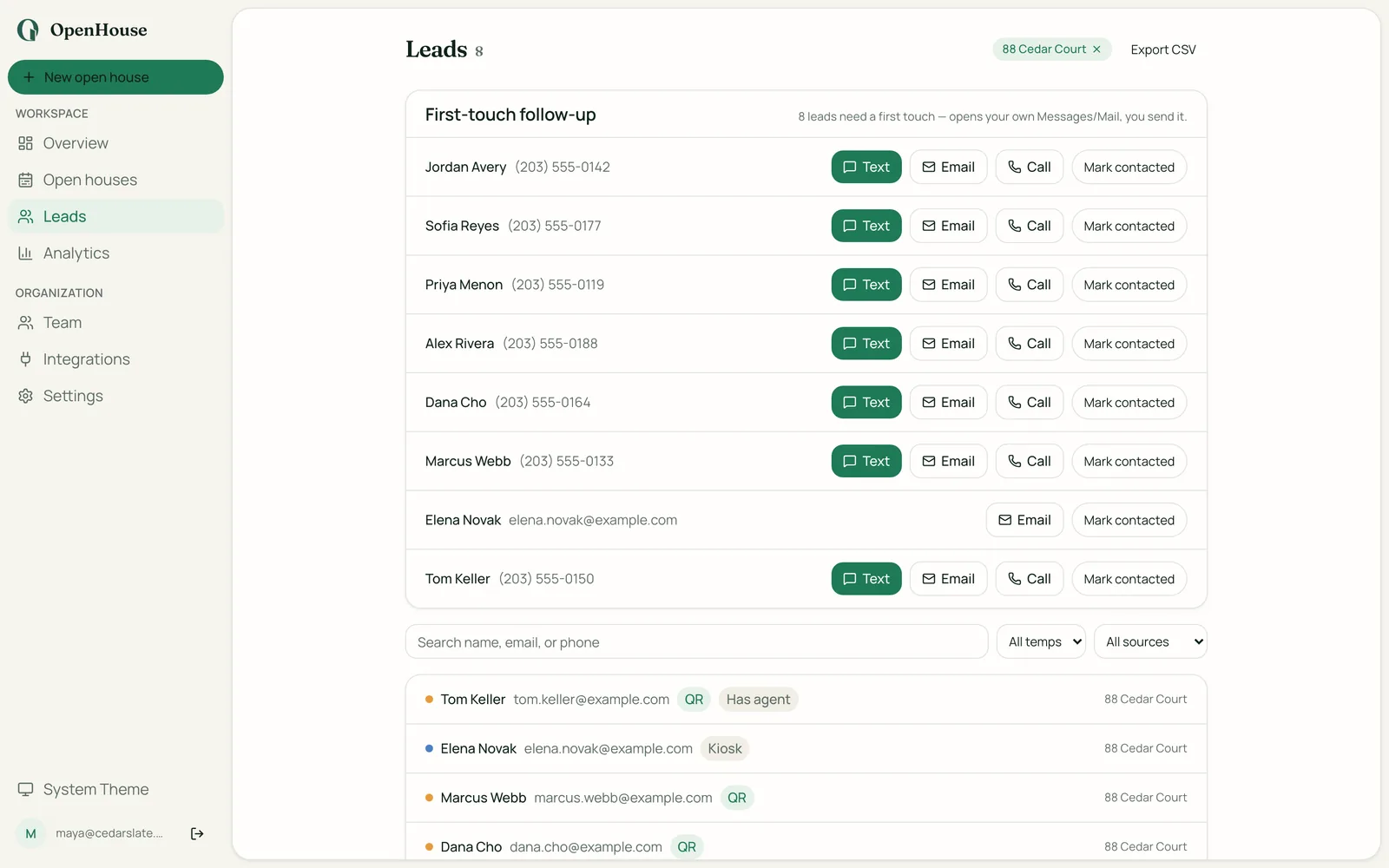
OpenHouse vs Spacio is a real head-to-head in 2026, because both are apps you can install today. Spacio Open House is on the App Store from HomeSpotter (a Lone Wolf company), and OpenHouse sits right next to it as an offline-first alternative. If you are weighing the two, this is an honest accounting of what the Spacio open house app does well, where its cloud model asks more of you, and where OpenHouse lands for the agent on door duty. Spacio is a capable tool that plenty of agents rely on, so this is a fair comparison, not a takedown.
The short version
- Spacio makes sense if you want social-profile enrichment on your visitors, deep two-way CRM sync, and brokerage-flavored seller reports, and running that on a cloud platform suits you. Spacio does not list pricing publicly.
- Choose OpenHouse if you want a sign-in app that captures leads with zero network calls, requires no account, keeps your data on the device until you export it, and hands leads off to the CRM you already use. You pay a flat subscription with a one-month free trial, and there is no separate setup fee.
If you are still surveying the field instead of weighing these two head-to-head, we keep every open house app comparison in one place.
What the Spacio open house app is
Here is only what we can verify, no embellishment. Spacio is the open house sign-in product from HomeSpotter, a brand that became part of Lone Wolf Technologies. The Spacio Open House listing is live on the Apple App Store, free to download, and was last updated in May 2026. It is a cloud platform: you create an account, visitors sign in on a branded flow, and the leads sync to Spacio's servers, where enrichment and CRM sync happen.
The point for a comparison is the model, not any rumor about the product. Spacio leans on an account, a connection, and the vendor's servers to do its headline work. That is a fine arrangement when you have Wi-Fi at the listing and want enrichment. It is a harder arrangement in a vacant house with one bar of LTE, which is exactly where the offline question below comes in.
If you want a closer look at Spacio on its own terms, we keep a full Spacio review with the same fair-trade-offs treatment, and it is a good read before any app shopping.
OpenHouse vs Spacio: feature comparison
The table below compares the two feature sets directly. Spacio does not publish pricing, so those cells say so rather than guess.
| OpenHouse | Spacio (HomeSpotter / Lone Wolf) | |
|---|---|---|
| Availability | Active on the App Store, native iPhone and iPad | Active on the App Store, last updated May 2026 |
| Price | $9.99/month or $79.99/year | Not listed publicly |
| Setup fee | None | Not listed publicly |
| Free trial | 1 month, full app | Not listed publicly |
| Connectivity model | Offline-first; zero network calls by design | Cloud platform with sync |
| Account required | No | Yes |
| Where lead data lives | On your device until you export it | In Spacio's cloud, tied to your account |
| Social-profile enrichment | None, by choice (no data-broker lookups) | Yes, a core selling point |
| CRM sync | Export and handoff, not live two-way sync | Deep two-way CRM sync |
| Sign-in experience | Single screen, built-in kiosk mode | Branded sign-in flow |
| Seller report | Built in, per listing | Yes, with brokerage flavor |
| CRM handoff targets | Follow Up Boss, HubSpot, BoldTrail, Lofty, Sierra, CSV, vCard | Two-way sync with supported CRMs |
| Platform | Native iPhone and iPad | iOS |
| If you stop paying | Read-only mode; all data stays exportable | Cloud access tied to your subscription |
That's the decision in one screen. The sections below get into why the two apps are built so differently, because the cloud-versus-device split is the real story of Spacio vs OpenHouse, and most of the other differences fall out of it.
The architecture difference: cloud sync vs true offline capture
Spacio is a cloud platform. That's not a knock; it's what powers the parts agents like, the CRM sync and the visitor enrichment. But a cloud platform leans, by definition, on a connection and on an account. That is a fine trade when you have reliable Wi-Fi at the listing, and a real question when you don't.
OpenHouse goes the other way on purpose. It makes zero network calls. The kiosk, the qualification flow, and every lead write happen in local storage on the iPad, full stop. No account, so nothing to log into at the door and nothing to sync afterward. This is true offline capture, not cloud sync, which matters more than it sounds when half of vacant listings are connectivity dead zones. The sellers moved out, the internet got cancelled, and the house with the concrete walls has one bar of LTE in the kitchen and none in the back bedroom where you set up the sign-in table. On a sync-dependent app, that's a problem you find out about at 2 PM on a Sunday. On OpenHouse, airplane mode is a supported configuration, not an edge case.
There's a quieter benefit here too. Because OpenHouse has no backend, there is no account to create and no server round-trip between a visitor tapping submit and the lead being saved. Every lead lives on the device you're holding. That's not marketing; it's a direct consequence of the offline-first design.
Pricing: a flat subscription with no setup fee
Spacio does not list pricing publicly on its website, so we are not going to put a number in your head that we cannot source. If pricing is part of your decision, ask Spacio directly for a current rate.
OpenHouse is $9.99/month or $79.99/year with a one-month free trial, and there's no setup fee at all. You install it, set up your listing, and run an event the same afternoon, with nothing to brand-configure before you capture a lead. You can read the full breakdown of OpenHouse pricing and the free month if the numbers are what you're weighing. One pricing behavior worth knowing about: if an OpenHouse subscription lapses, the app drops into a data-safe read-only mode. Every lead you captured stays viewable and exportable. A lapse only stops you from running new events. It never touches the data you already have.
Export and lock-in: get your leads out on demand
Here the OpenHouse vs Spacio comparison shifts from features to control. Spacio keeps your leads in its cloud, tied to your account, which is convenient right up until you want a clean copy on your own terms. Getting years of buyer conversations, neighbor contacts, and sphere-of-influence names out of a cloud tool means working through its export path and whatever account state you happen to be in.
OpenHouse is built the other way. It's export-first: CSV, PDF, Contacts, vCard, and a clean share into the CRM you already use (Follow Up Boss, HubSpot, BoldTrail, Lofty, or Sierra) sit at the front door, not buried in settings, and the data lives on your iPad to begin with. We built it to be export-first, so you're never locked in, and that test, "how do I get my leads out, today, without asking permission?", should be the first question you put to any sign-in app, ours included. If the answer is a support ticket, keep shopping.
What Spacio does that OpenHouse deliberately does not
Fairness means spending real time here, because Spacio genuinely does things OpenHouse doesn't, and pretending otherwise would make this comparison useless to you.
Spacio's headline features are social-profile enrichment and deep two-way CRM sync. Enrichment means that when a visitor signs in, Spacio can append public social and professional data to that contact, so you walk away with a fuller profile than the name and email the person actually typed. For some agents that is the entire value: a richer picture of who came through the door, ready to drop into a nurture sequence.
OpenHouse doesn't do this, and the omission is a choice, not a gap we forgot to fill. OpenHouse makes zero network calls and never pulls from third-party data brokers, so it can't enrich a profile even if you asked it to. The information you get is the information the visitor chose to give you. We think that's the right privacy posture, and plenty of sellers and visitors agree once you explain it to them. But if enrichment is specifically why you use the Spacio open house app, know going in that OpenHouse isn't a one-to-one replacement on that front. Same goes for live two-way CRM sync. OpenHouse hands leads off through export and share, cleanly, but it doesn't hold a continuous two-way connection into your CRM the way Spacio does. We're a capture-and-handoff tool, not a CRM, and we never claim to be one.
If those two capabilities are the core of your workflow, be honest with yourself about it. A focused offline sign-in app will feel lighter. For most solo agents, whose real job is capturing visitors, qualifying them, and following up fast, that lightness is the whole point. For the few who built a pipeline around enrichment, it's a genuine trade.
Lead quality: triage at capture instead of enrichment after
Even without enrichment, an OpenHouse export isn't a flat pile of names. The app puts triage inside capture. Every visitor drops into a bucket while the context is fresh: represented buyer, unrepresented hot lead, neighbor, investor, or incomplete sign-in. By Monday morning your export is already a prioritized callback list, sorted by who's worth a call first. The single-screen form is deliberate too. Nobody holding a coffee and a toddler wants a multi-step wizard, and a shorter form means fewer abandoned sign-ins, which is the lead-count problem sitting underneath every sign-in app. Industry roundups like The Close's open house app guide keep landing on the same point: the best app is the one visitors actually finish signing into.
So the two apps answer "how do I know who to call?" in opposite ways. Spacio enriches the contact after the fact with outside data. OpenHouse qualifies the contact in the moment with the agent's own read of the room. One pulls from data brokers; the other trusts the human at the door. Which you prefer tells you a lot about which app fits you.
Spacio makes sense if…
- You want social-profile enrichment. A fuller contact record straight off the sign-in is a real Spacio strength, and OpenHouse doesn't replicate it.
- You lean on deep two-way CRM sync. Spacio holds a live connection into your CRM that a capture-and-export tool doesn't match.
- You want a brokerage-flavored seller report and are fine on a cloud platform. Spacio is built with that context in mind.
Spacio is a live product: still on the App Store, last updated in May 2026. If its cloud-and-enrichment model fits how you work, it's a reasonable pick, and this comparison isn't trying to talk you out of it.
Choose OpenHouse if…
- You want your data to stay on your device. There's no account to create and no backend holding your leads, so nothing to log into at the door and nothing to sync afterward.
- Your listings have unreliable connectivity. Zero network calls means the dead-zone colonial captures leads exactly like the fiber-connected condo.
- You want privacy by architecture. Leads never leave the device unless you export them, there's no enrichment pulling from data brokers, and no account to create.
- You want triaged leads and a clean exit. Qualification buckets at capture, then CSV, PDF, Contacts, vCard, or CRM handoff into whatever you already run.
If you want to see how OpenHouse stacks up against another live tablet sign-in option, our OpenHouse vs Open Home Pro comparison covers the one many agents look at next.
So where does that leave your choice?
The OpenHouse vs Spacio question comes down to the cloud-versus-device split. Spacio does things OpenHouse doesn't, enrichment and live CRM sync chief among them, and if those are your core workflow, no offline-first sign-in app will feel identical. OpenHouse answers the part of the job most agents actually do, capturing and qualifying visitors at the door, then hands the leads cleanly to wherever you already work, with the data living on your device the whole time. Reporting like HousingWire's coverage of open house tools keeps circling the same lesson: own your lead data, and pick a tool that lets you walk out with it.
If you want the wider field instead of this one head-to-head, here's the full list of Spacio alternatives with the same fair-trade-offs treatment. And if OpenHouse looks like your lane, the first month is free to try.
Frequently asked questions
Is Spacio still available?
Yes. Spacio Open House is on the Apple App Store from HomeSpotter, LLC (a Lone Wolf company), free to download, and its most recent update landed in May 2026. It is a live product, so this comparison weighs two apps you can install today.
How much does Spacio cost?
Spacio does not list pricing publicly on its website, so we do not quote a monthly figure here. OpenHouse is flat: $9.99 per month or $79.99 per year, with a one-month free trial and no setup fee.
Is OpenHouse a good Spacio alternative?
For a solo agent who mainly wants iPad sign-in and lead capture, yes. OpenHouse works fully offline, requires no account, keeps leads on your device, and exports to CSV, vCard, and CRMs like Follow Up Boss and HubSpot. It does not aim to replace Spacio's CRM sync or social-profile enrichment.
Can I move my Spacio leads to OpenHouse?
You export from Spacio first, then import the resulting CSV into your CRM or address book. OpenHouse captures new leads going forward and exports them the same way, to CSV, vCard, or a CRM handoff.
What did Spacio do that OpenHouse doesn't?
Spacio offers social-profile enrichment of your visitors and deep two-way CRM sync. OpenHouse deliberately does neither, because it makes zero network calls and never pulls data from third-party brokers. If enrichment is the reason you use Spacio, that is a real difference.