
Spacio review searches in 2026 usually come down to one question: is this the right open house sign-in app for how you actually work? Spacio Open House is a live product from HomeSpotter (a Lone Wolf company), and its App Store listing was last updated in May 2026. This review walks through what Spacio does, how its cloud-first design shapes the experience, what it costs, and how it compares to OpenHouse, our offline-first app, so you can decide which one fits your open houses.
Full disclosure before we get into it: OpenHouse is our app, and it is one of the alternatives we suggest at the end. We have tried to be straight about both products. If you want to skip directly to alternatives, the Spacio alternatives roundup has the full field.
What is Spacio?
Spacio is an iOS open house sign-in and lead capture app built by HomeSpotter, a company that is now part of Lone Wolf Technologies, one of the large real estate software conglomerates. The app targets agents and brokerages who want a branded digital sign-in experience with cloud sync built in. Visitors sign in on an iPad, and Spacio ties that information to social-profile enrichment and a CRM pipeline on the backend. On the Spacio App Store listing the app is free to download and was last updated in May 2026.
Spacio pricing: what it costs
Spacio does not list pricing publicly. The App Store download is free, and beyond that the app is quoted through HomeSpotter or bundled into a brokerage's Lone Wolf platform contract rather than posted on a public rate card. If you have seen monthly or setup figures quoted in agent forums, treat them as unofficial: there is no current published price to check them against.
That opacity is itself a comparison point. OpenHouse posts a flat price you can read before you sign up: $9.99 per month or $79.99 per year, with a one-month free trial. You know the number before you commit, and there is no quote to request and no rate card to wait on.
Some agents reach Spacio through their brokerage, where office accounts with Lone Wolf can bundle it as part of a larger platform package. For those agents, Spacio's cost is baked into a brokerage contract and less visible at the personal level.
What Spacio does well
A fair Spacio review means spending real time here, because the app genuinely delivers things that simpler sign-in apps do not.
Social-profile enrichment is Spacio's headline feature. When a visitor signs in, Spacio can append social and professional data from public sources to that contact record, so you leave the open house with a richer profile than just the name and phone number the visitor typed. For agents building targeted follow-up sequences, that context matters. You know something about the person before the first call.
Deep two-way CRM sync is the other real strength. Spacio holds a live connection into supported CRM platforms. Sign a visitor in, and the contact appears in your CRM pipeline without a manual import step. For brokerage environments where the CRM is the system of record, that direct path is meaningful. The alternative, capture on an iPad, export CSV, import to CRM, deduplicate, is genuinely more work.
Brokerage-flavored seller reports are another point of differentiation. Agents can give sellers a clean visual breakdown of open house attendance. Combined with the enrichment data, Spacio can produce something polished enough for a listing appointment conversation.
The branded sign-in experience is a selling point for agents who care about presentation. Spacio offers a sign-in screen that carries your logo and brokerage identity, rather than a generic interface.
For a cloud-connected, brokerage-oriented team with a CRM at the center of their pipeline, those four capabilities are a coherent package.
Where OpenHouse and Spacio differ
The biggest difference between the two apps is not a feature checkbox, it is the architecture underneath.
Spacio is cloud-first. Enrichment, CRM sync, and the seller report all run through Spacio's backend, and using the app means creating a Spacio account and signing in. That design is what makes the live enrichment and CRM connection possible, and for a brokerage that keeps its CRM at the center of everything, it fits.
OpenHouse is offline-first. It makes zero network calls. The kiosk, the sign-in flow, and every lead write go into local storage on your device and stay there until you export them deliberately. There is no account to create and no backend to depend on. The trade is direct: OpenHouse does not enrich profiles and does not hold a live CRM connection, and in exchange your capture keeps working with no Wi-Fi and your lead data never leaves the iPad unless you send it.
Because Spacio is cloud-first, your lead data lives in Spacio's system behind a Spacio account, and a full export runs through that account and its web portal. Because OpenHouse is offline-first, your leads sit on the device from the moment they are typed, and you can export them to a file you control at any time. Neither approach is automatically right: it depends on whether you want the convenience of cloud sync or the control of local storage. The question worth asking about any sign-in app is simple: how do I get my leads out today, without asking permission? The sign-in data you collect at an open house belongs to your business relationships, and it should live somewhere you control.
What Spacio does that most alternatives do not
Honest alternatives coverage means acknowledging the gap. Most apps that look like Spacio alternatives do not actually do what Spacio does.
Social-profile enrichment is largely absent from the solo-focused alternatives. OpenHouse deliberately does not do it, because the app makes zero network calls and never pulls from data brokers. The visitor information you collect is exactly what the visitor typed, nothing more, and it is never sold. That is a privacy choice, and one that sellers and visitors increasingly appreciate, but it is a real difference from what Spacio offers.
Deep two-way CRM sync is also largely absent from solo apps. OpenHouse does a clean export handoff to whatever CRM you already use, Follow Up Boss, HubSpot, BoldTrail, Lofty, Sierra, plus CSV and vCard, but it does not hold a continuous live connection into your CRM. That is a real distinction for an agent who built their follow-up pipeline around CRM-first capture.
If those two capabilities are the core of why you use Spacio, no simple sign-in app fully replaces them. The honest path is to weigh that trade against the gains in offline reliability, data ownership, and flat pricing.
Spacio alternatives: the realistic field
For agents comparing the options head to head, here is the realistic field.
| App | Price | Offline? | Account required? | Lead data location | Best for |
|---|---|---|---|---|---|
| OpenHouse | $9.99/mo or $79.99/yr | Yes, fully | No | On your device | Solo agents, offline-first, privacy-priority |
| Spacio | Not listed publicly | No, cloud-connected | Yes | Cloud, tied to your account | Brokerage teams wanting enrichment and CRM sync |
| Curb Hero | Free | Partial | Yes | Cloud, shared with lenders on opt-in | Agents who want $0 and accept the lender model |
| Open Home Pro | Free tier + paid | Sync-later | Yes | Cloud, uploads on reconnect | Tablet-dedicated agents in the Open Home Pro ecosystem |
For the full walk-through of each option with honest trade-offs, see the complete Spacio alternatives comparison. For a head-to-head of OpenHouse and Spacio specifically, including the feature table and what Spacio does that we don't, the OpenHouse vs Spacio comparison covers all of it.
OpenHouse: the offline-first option
OpenHouse is built around one idea: your open house should work whether or not the internet does. It makes zero network calls. The kiosk, the sign-in flow, and every lead write go into local storage on your device and stay there until you export them deliberately. No account to create, no backend to sync with, no cloud platform that someone else controls. If a subscription lapses, the app drops into a data-safe read-only mode: every lead you captured stays viewable and exportable forever. The only thing a lapse stops is running new events.
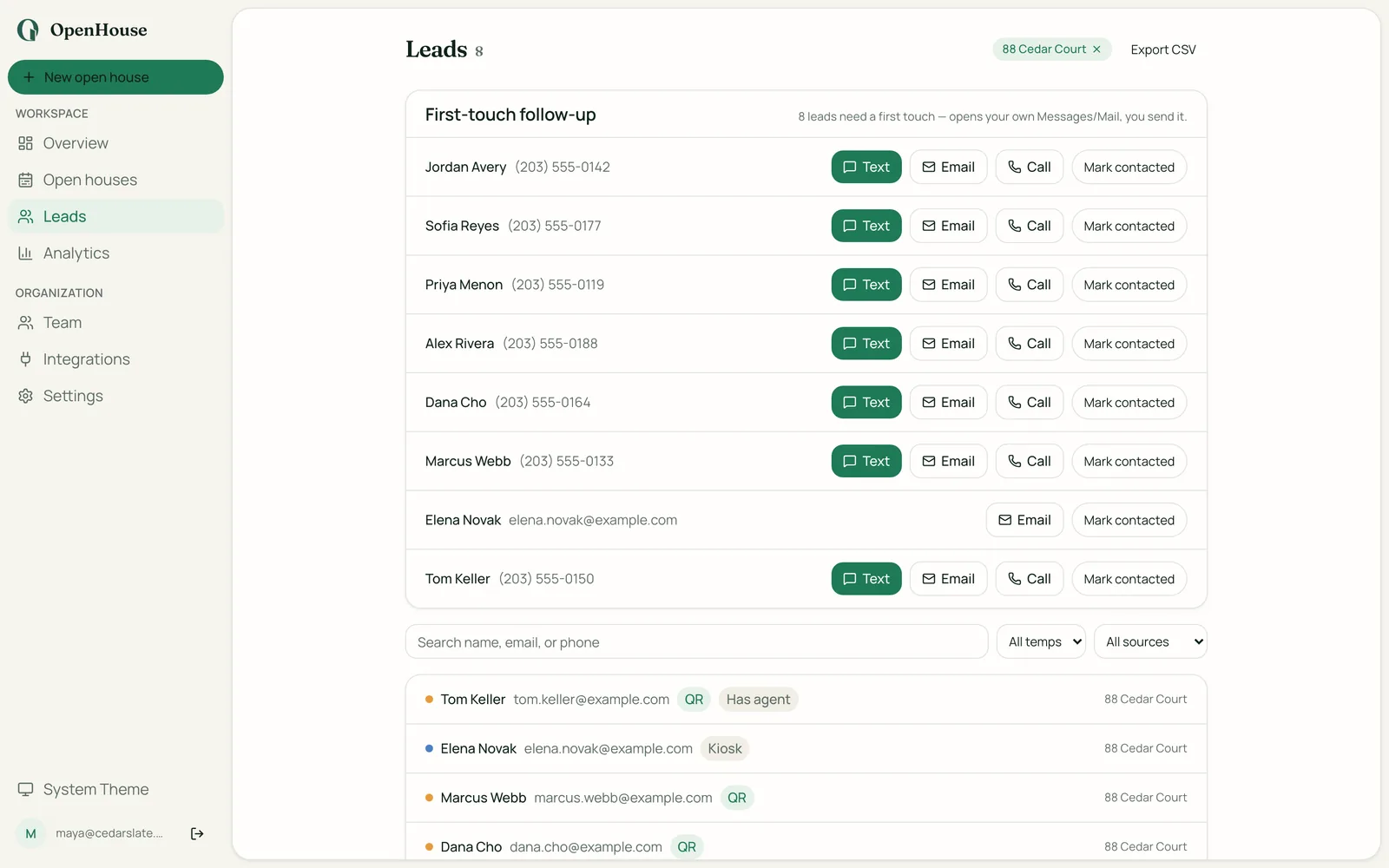
OpenHouse does not enrich profiles and does not hold a live CRM connection. What it does do: true offline lead capture that works in airplane mode in a concrete basement, an in-session triage system that turns visitors into a Monday callback priority list, and export to the CRM you already use as a front-door feature, including Follow Up Boss, HubSpot, BoldTrail, Lofty, Sierra, CSV, and vCard. Pricing is $9.99 per month or $79.99 per year, with a first month free to try it.
Curb Hero: the free option
Curb Hero is free, genuinely popular, and holds a 4.9-star rating. For agents watching every recurring cost, the price is hard to argue with. The trade-off is the business model. Curb Hero is monetized through lender co-marketing, and as their own help center explains, a default lender may be assigned to your listings and visitor data is shared with lenders when visitors opt into mortgage questions. If you are comfortable with that model, it is a strong free option. If you are protective of where your lead data goes, weigh it carefully.
Open Home Pro: the established tablet option
Open Home Pro has been in the category for years and many agents will recognize the interface immediately. Two practical notes: the sign-in experience is tablet-only, so a dedicated iPad is required. And its offline handling is a sync-later model, sign-ins captured without connectivity upload when you are back online. In a dead-zone listing, that is a distinction that matters. The full app roundup from Showable gives a neutral read on where Open Home Pro sits in the current field.
Which one fits your open houses
Choose Spacio if cloud enrichment and a live CRM connection are the heart of your workflow, you run inside a brokerage that already lives on Lone Wolf tools, and you are fine quoting the price through HomeSpotter rather than reading it off a public page.
Choose OpenHouse if you want capture that works with no connection at all, lead data that stays on your device and is never sold or co-branded with lenders, a flat published price, and export to the CRM you already use. Before you commit either way, run your chosen app in airplane mode and try to capture five sign-ins with no connection. If it can't, you have learned something important before it matters at a live event.
Spacio review: the summary
Spacio is a real product with real capabilities: social-profile enrichment and two-way CRM sync are genuine advantages for brokerage-connected agents, and the app is still available and was last updated in May 2026. Its cloud-first design is what powers those features, and it is also what ties your workflow and your lead data to a Spacio account and a live connection.
OpenHouse takes the opposite bet: offline-first capture, on-device privacy, a flat published price, and export to the CRM you already use. If enrichment and live CRM sync are the core of your pipeline, Spacio's model fits. If offline reliability, data ownership, and a price you can read up front matter more, OpenHouse is the closer match.
For what comes next, you have options. If you want the full field: best open house apps in 2026. If you want the head-to-head against the app this review points toward: OpenHouse vs Spacio.
Frequently asked questions
Is Spacio still available in 2026?
Yes. Spacio Open House is available in the Apple App Store from HomeSpotter, LLC (a Lone Wolf company), and its listing was last updated in May 2026. The app is free to download.
How much does Spacio cost?
Spacio does not list pricing publicly. The App Store download is free, and any paid tiers are quoted through HomeSpotter or bundled into a brokerage contract rather than posted on a public rate card. If you want a fixed, published price, OpenHouse is $9.99 per month or $79.99 per year with a one-month free trial.
How is OpenHouse different from Spacio?
Spacio is a cloud-connected sign-in app with social-profile enrichment and CRM sync. OpenHouse is offline-first: it makes zero network calls, keeps every lead on your device, never sells data or co-brands with lenders, and exports to Follow Up Boss, HubSpot, BoldTrail, Lofty, Sierra, CSV, and vCard.
What does Spacio do well?
Spacio's strengths are social-profile enrichment of sign-in visitors and two-way CRM sync, plus a brokerage-flavored seller report. For cloud-connected, brokerage-oriented teams those are real advantages over simpler sign-in apps.
Does Spacio work offline?
Spacio is a cloud-connected app, so its enrichment and CRM sync depend on a live connection and a Spacio account. OpenHouse takes the opposite approach: it captures sign-ins with no Wi-Fi at all and stores them on the device, which matters in a basement or a dead-zone listing.
What is the best Spacio alternative?
It depends on what you use Spacio for. Solo agents who mainly need iPad sign-in and offline lead capture will find OpenHouse closest. Agents who want a free option can look at Curb Hero, with the trade-off that lead data is shared with paired lenders.